Exercise and strength training in menopause: what it does and does not help
Regular exercise, especially strength training, helps protect bone, muscle, heart health and mood during and after menopause. Trials have not shown that it reduces hot flashes or night sweats.
See a doctor before starting hard exercise if you have heart disease, chest pain, dizziness, uncontrolled blood pressure, osteoporosis with past fractures, or joint pain that limits movement.
What it is
Exercise covers any planned physical activity. Mayo Clinic groups it into four types: aerobic (walking, cycling, swimming), strength, flexibility and balance.1
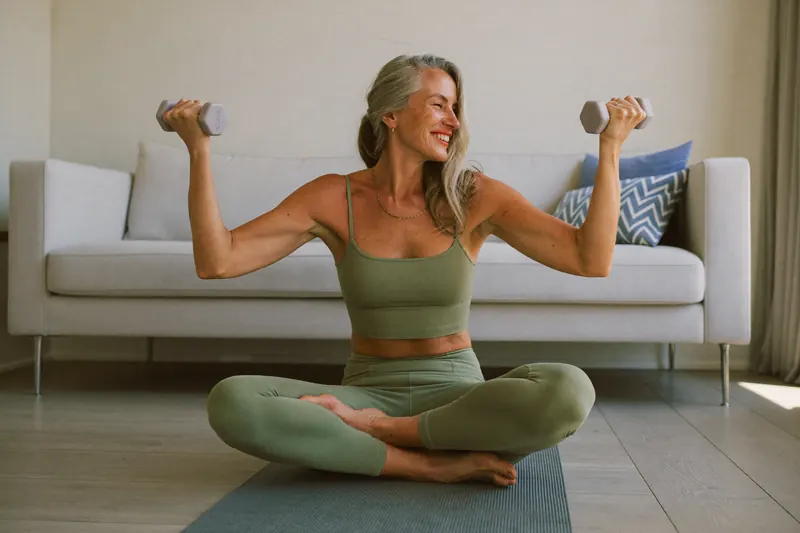
Strength training means working muscles against resistance. This can be weight machines, hand weights, resistance bands or body weight. Mayo Clinic suggests a level that tires the muscles after about 12 repetitions.1
For most healthy women, Mayo Clinic suggests at least 150 minutes of moderate aerobic activity a week, or 75 minutes of vigorous activity. It adds strength training at least twice a week.1
What the research shows for bone and body
Bone loss speeds up after menopause. A Cochrane review pooled 43 trials with 4,320 people, mostly postmenopausal women. Exercise had a small but real effect on bone density compared with no exercise.2
Programs that mixed several types of exercise did best for the spine. Strength training for the legs did best for the hip. The review found no clear effect on the number of fractures, and the quality of reporting was low.2
The Australian LIFTMOR trial tested supervised, high-intensity lifting and impact training. The full trial included 101 women with low bone mass and ran for 8 months. Spine and hip bone density improved compared with a gentle home program. Spine density rose by 2.9%, while it fell by 1.2% in the comparison group.3
A later LIFTMOR report found the training did not cause new spine fractures. It also improved a forward-curving upper back.4 The sessions were supervised by trained staff, which matters for safety.
Mayo Clinic says exercise helps prevent the belly fat gain and muscle loss that are common around menopause. It also links being active with a lower risk of depression and decline in thinking skills.1
What the research shows for hot flashes
A Cochrane review looked at 5 trials with 733 women. In 3 trials, exercise did no better than no treatment for how often or how badly hot flashes happened. The evidence was low quality.5
The Menopause Society reviewed this in 2023. It does not recommend exercise as a treatment for hot flashes. A pooled analysis of 4 US trials with 1,005 women found exercise and yoga gave smaller improvements than other options.6
This does not mean exercise is useless in menopause. Mayo Clinic notes it is not a proven way to ease hot flashes or sleep problems, but it can still improve overall quality of life.1
Safety and who should be careful
Most women can exercise safely. Start gently and build up over time. Mayo Clinic suggests beginners can start with about 10 minutes a day.1
If you have osteoporosis or past fractures, ask a doctor or physical therapist which movements suit you. High-intensity programs like LIFTMOR were tested with close supervision.4
Balance exercises such as tai chi or standing on one leg can improve stability. This may help lower the risk of falls.1
Availability and the bottom line
Exercise is free or low cost and available everywhere. Options include walking, home workouts, gyms, community classes and water exercise. In some countries, doctors can refer women to physical therapists or exercise programs for bone health.
Exercise is one of the most useful things you can do for long-term health in midlife. Its clearest benefits are for bone, muscle, heart health and mood.1,2
It is not a reliable treatment for hot flashes. If hot flashes are the main problem, talk to a doctor about options with stronger evidence, such as hormone therapy, non-hormonal prescription treatments or CBT.6
A mix of aerobic, strength and balance work gives the widest range of benefits. Any amount is better than none.1
What it is used for: evidence rated
| Option | Evidence | What the research shows |
|---|---|---|
| Bone loss | A Cochrane review of 43 trials found a small but real gain in bone density; no clear effect on fractures yet.2 | |
| Weight gain and muscle loss | Recommended by Mayo Clinic to limit belly fat gain and muscle loss; no menopause-specific trial numbers were found in the sources reviewed.1 | |
| Low mood | Active adults have a lower risk of depression, according to Mayo Clinic; this comes mainly from observational research.1 | |
| Hot flashes and night sweats | Trials found no benefit over no treatment, and The Menopause Society does not recommend it for hot flashes.5,6 |
Ratings explained: how we rate. Always talk to a doctor or pharmacist before starting a medicine or supplement.
Related
Sources
- Women's Wellness: Fitness tips for menopause, Mayo Clinic News Network (2019)
- Exercise for preventing and treating osteoporosis in postmenopausal women (Howe et al., Cochrane 2011), McMaster Optimal Aging summary
- High-intensity resistance and impact training improves bone mineral density and physical function in postmenopausal women with osteopenia and osteoporosis: the LIFTMOR randomized controlled trial, J Bone Miner Res (2018)
- High-intensity exercise did not cause vertebral fractures and improved thoracic kyphosis (LIFTMOR), Osteoporosis International (2019)
- Exercise for vasomotor menopausal symptoms, Cochrane review abstract (2014)
- The 2023 nonhormone therapy position statement of The North American Menopause Society, Menopause (2023)