Pilates for menopause: core strength, posture and what to expect
Small trials suggest Pilates can improve balance, posture and possibly mood and sleep in women after menopause. It has not been shown to ease hot flashes or to build bone on its own.
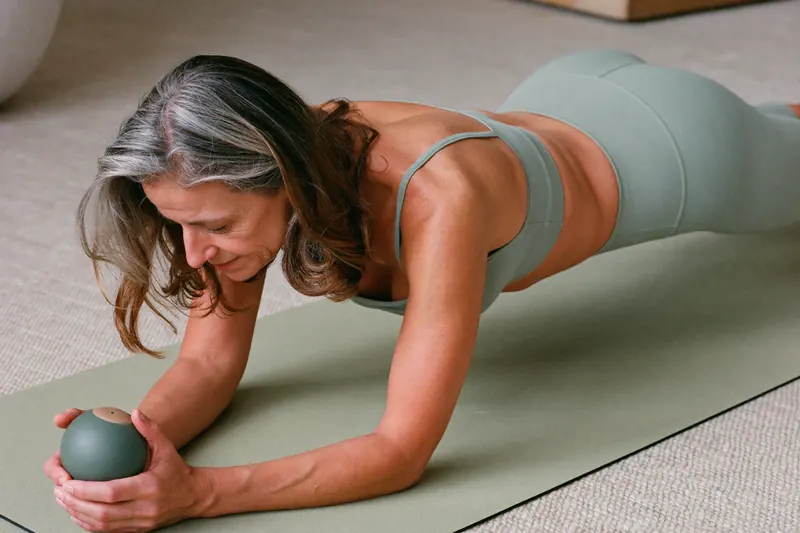
Check with a doctor or physical therapist first if you have osteoporosis, a past spinal fracture, recent back injury or surgery, or pelvic floor problems.
What Pilates is
Pilates is a system of controlled movements that focus on the deep core muscles, breathing and posture. Joseph Pilates developed it in the early 20th century.4
You can do it on a mat or on equipment such as a reformer. Neither is automatically easier. Mat work means lifting your own body weight against gravity.4
Pilates is low-impact and can be adapted for most fitness levels, which makes it a popular choice for women returning to exercise in midlife. Classes often focus on slow, precise movement rather than speed.
What the research shows
Research on Pilates in menopause is still small. A 2020 review found three good-quality trials in women after menopause, each with 41 to 110 women.1 Twice-weekly classes improved balance, posture, sleep, anxiety, low mood and fatigue.1
A 2024 review of mind-body exercise in midlife women, which included Pilates, yoga and tai chi, also found better sleep, anxiety, mood and fatigue.2 The results were not broken down by type of exercise, so it is hard to say how much came from Pilates itself.2
For bone, two small Pilates studies in that review reported gains in bone mineral.2 However, a wider review of Pilates and yoga found no clear difference in bone density compared with control groups.3 The authors noted that holding bone steady after menopause may still be worthwhile.3
There are no published trial results yet on Pilates for hot flashes. At least one trial comparing Pilates with aerobic exercise for menopausal symptoms has been registered, but results were not available.5
Cleveland Clinic notes that many Pilates studies are small and short, so a lot of the support is still anecdotal.4
How to start safely
A good first step is a beginner class with a qualified instructor, who can check your alignment. Cleveland Clinic suggests starting slowly and expecting some muscle soreness at first.4
- Tell the instructor about back pain, joint problems, pelvic floor problems or a past injury.
- If you have back problems or are recovering from surgery, speak to your doctor first. Some movements may need changing.4
- Learn on a reformer with a teacher before buying equipment for home use.4
Many classic Pilates moves, such as the "roll up" or "hundred", involve curling the spine forward. If you have osteoporosis, avoid loaded forward bending, such as sit-ups and toe touches.7 Experts advise changing activities rather than banning them, and adding exercises that strengthen the back muscles.6 Ask for a teacher with experience of osteoporosis, or a physical therapist.
Do you have a heart condition, diabetes, high blood pressure or another health problem? Have you been inactive for a long time? If so, check with your doctor before you start.9 Stop and get urgent help if you have chest pain, dizziness or a racing heartbeat. The same applies to breathlessness that does not settle with rest.9
Menopause is one of the times when pelvic floor problems become more likely.10 If you have leaking, heaviness or prolapse, ask for exercises that do not put a lot of downward pressure on the pelvic floor.10 A pelvic floor physical therapist can help you choose.
Pregnancy is still possible in perimenopause, until periods have stopped for 12 months.11 If you are or might be pregnant, ask your doctor or midwife which activities suit you.
Where Pilates fits
Pilates is a useful way to build core strength, posture and body awareness. Cleveland Clinic suggests pairing it with strength training and aerobic exercise.4
WHO guidance for adults is 150 to 300 minutes of moderate aerobic activity a week, plus muscle-strengthening on at least two days.8 Some reformer classes can count toward the strength part. See strength training for women over 40.
What it is used for: evidence rated
| Option | Evidence | What the research shows |
|---|---|---|
| Balance and posture | A review of three good-quality trials in postmenopausal women found improvements in balance and posture.1 | |
| Mood and anxiety | Small trials report less anxiety and low mood, but they are few and often pooled with other mind-body exercise.1,2 | |
| Sleep | Small trials and a mind-body exercise review suggest better sleep, but Pilates-only data are limited.1,2 | |
| Fatigue | Reported to improve in small trials of postmenopausal women.1 | |
| Bone strength | Two small studies reported gains, but a broader review found no clear bone density benefit compared with controls.2,3 | |
| Hot flashes | There are no published trial results yet on Pilates for hot flashes; at least one trial has been registered.5 |
Ratings explained: how we rate. Always talk to a doctor or pharmacist before starting a medicine or supplement.
Related
Products to explore
Sources
- Benefits of the Pilates method for postmenopausal women: systematic review, Research, Society and Development (2020)
- Mind-body exercise in peri- and postmenopausal women: systematic review of 11 trials (Xu et al., Menopause 2024), IntraMed summary
- Effectiveness of Pilates and yoga to improve bone density in adult women: a systematic review and meta-analysis, PLoS ONE (2021)
- Everything you want to know about Pilates, Cleveland Clinic (2023)
- Clinical Pilates and aerobic exercise in menopause (registered study record), Epistemonikos (2023)
- Strong, steady and straight: UK consensus statement on physical activity and exercise for osteoporosis, BJSM blog (2023)
- Osteoporosis and exercise, Better Health Channel, Victoria State Government
- Physical activity fact sheet, World Health Organization Europe
- How to get the exercise you need, CardioSmart, American College of Cardiology
- What are pelvic floor safe exercises? Pelvic Floor First, Continence Foundation of Australia
- Can you get pregnant during perimenopause? University Hospitals (2025)