Walking and running in menopause: benefits, limits and how to start
Regular walking or running supports heart health, mood, sleep and a healthy waistline in midlife. It does not reliably reduce hot flashes, and walking alone does little for bone density.
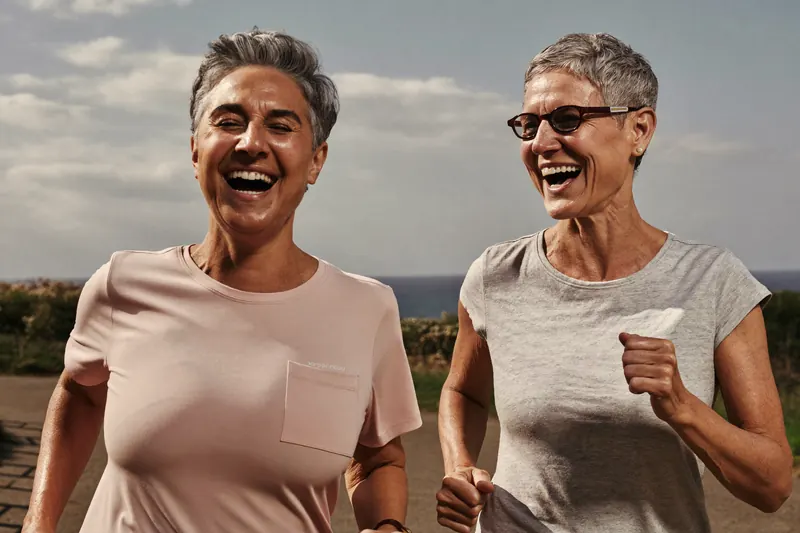
Talk to a doctor before starting if you have heart disease, chest pain, diabetes or high blood pressure, or before running if you have osteoporosis or a past fracture. Seek urgent help for chest pain, fainting or a racing heartbeat during exercise.
Why it matters in midlife
Walking is free, needs no special skills and can start from your front door. Running suits women who want more challenge.
WHO links regular aerobic activity with lower risk of heart disease, type 2 diabetes, and breast and colon cancer, plus better mood.1 The European Menopause and Andropause Society says too little activity is linked to a 20 to 30% higher risk of early death.2
A large US study looked at women with an average age of 72.9 Those taking about 4,400 steps a day had a 41% lower risk of death than those taking about 2,700.9 The benefit leveled off at about 7,500 steps. This study was observational, so it shows a link, not proof.9
What the research shows for menopause
Mood. A 2025 review of 17 trials in menopausal women found that leisure activity, much of it walking, reduced depression and low mood.3 Certainty was low to moderate.3 A 2026 review of 12 trials found aerobic exercise, including walking and dance, had the strongest effect on depression and quality of life.4
Sleep. A review of 17 trials in menopausal women found exercise, most often walking, reduced insomnia severity. Overall sleep quality scores did not change significantly.5
Waistline. In a year-long trial of 400 inactive postmenopausal women, 300 minutes a week of aerobic exercise reduced belly fat more than 150 minutes.6 Most women walked, cycled, ran or used an elliptical trainer.6
Bone. A review of 10 trials found walking alone did not change spine bone density. There was a possible benefit at the hip with programs longer than six months.7
Hot flashes. A Cochrane review found too little evidence to show exercise reduces hot flashes.8 The Menopause Society does not recommend exercise as a treatment for them.11
How to start
WHO advises adults to aim for 150 to 300 minutes of moderate aerobic activity a week, or 75 to 150 minutes of vigorous activity.1 That can be built from short walks spread across the week. The International Menopause Society notes that small amounts still make a difference.12
- Start with shorter, easier sessions and build up gradually, with a warm-up and cool-down.10
- If you have not exercised for a while, begin with about five minutes and build up toward 30 minutes a day.13
- Use the talk test. At a moderate pace you can still chat with a friend, but with some effort.13
- Wear comfortable, supportive shoes, and choose even, well-lit routes.13 Using a cane or walking poles for balance is fine.13
- If you would like to run, a walk-run approach lets your joints, heart and muscles adjust gradually.
- Avoid extreme heat or high air pollution, and drink fluids.10 Carrying a layer you can remove helps if hot flashes are a problem.
If you have osteoporosis, walking is usually a good choice for fitness, and strength work can be added to protect bone. If you have had a spinal or other fracture, or have a high risk of falls, check with your doctor or a physical therapist before running or other high-impact exercise. If you have joint pain, try flatter routes, shorter sessions or water exercise.
Do you have a heart condition, diabetes, high blood pressure or another health problem? Have you been inactive for a long time? If so, check with your doctor before you start.10 Stop and get urgent help if you have chest pain, dizziness or a racing heartbeat. The same applies to breathlessness that does not settle with rest.10
Running is high-impact, and pelvic floor problems are more common around menopause.14 If you leak urine or feel heaviness when you run, try lower-impact options and ask your doctor or a pelvic floor physical therapist for advice.14
Pregnancy is still possible in perimenopause, until periods have stopped for 12 months.15 If you are or might be pregnant, ask your doctor or midwife which activities suit you.
Getting more from your walks
For bone and muscle, combine walking with strength training on two or more days a week.1 See strength training for women over 40 and exercise and strength training.
Walking with a friend or group can help you keep going. Group formats were common in the menopause trials showing mood benefits.4
What it is used for: evidence rated
| Option | Evidence | What the research shows |
|---|---|---|
| Heart health and long-term health | WHO guidance, based on wide evidence in adults, links regular aerobic activity to lower risk of heart disease, diabetes and early death.1,2 | |
| Mood and low mood | Reviews of trials in menopausal women show less depression with walking and other aerobic activity, though certainty is low to moderate.3,4 | |
| Sleep | Exercise, mostly walking, reduced insomnia severity in menopausal women, but overall sleep quality scores did not change significantly.5 | |
| Weight around the middle | One large trial in postmenopausal women found more aerobic exercise led to more loss of belly fat.6 | |
| Bone strength | Walking alone did not improve spine bone density; there may be a small hip benefit with longer programs.7 | |
| Hot flashes | A Cochrane review found insufficient evidence that exercise reduces hot flashes.8 |
Ratings explained: how we rate. Always talk to a doctor or pharmacist before starting a medicine or supplement.
Related
Sources
- Physical activity fact sheet, World Health Organization Europe
- Menopause Essentials: Exercise, European Menopause and Andropause Society (2026)
- Effect of leisure-time physical activity on depression in menopausal women: systematic review and meta-analysis of RCTs, Frontiers in Psychiatry (2025)
- Exercise can help women in menopause feel better (review of 12 trials in Menopause), HealthDay via Powers Health (2026)
- The effect of exercise intervention on improving sleep in menopausal women: a systematic review and meta-analysis, Frontiers in Medicine (2023)
- High vs moderate volume of aerobic exercise and body fat in postmenopausal women (Friedenreich et al., JAMA Oncology), ScienceDaily (2015)
- Effects of walking on the preservation of bone mineral density in perimenopausal and postmenopausal women: systematic review and meta-analysis
- Exercise for vasomotor menopausal symptoms (Cochrane review 2014), Australasian Menopause Society summary
- Association of step volume and intensity with mortality in older women (Lee et al., JAMA Internal Medicine), ScienceDaily (2019)
- How to get the exercise you need, CardioSmart, American College of Cardiology
- The 2023 nonhormone therapy position statement of The North American Menopause Society, Menopause (2023)
- Physical activity and menopause, World Menopause Day factsheet, International Menopause Society (2025)
- Walking tips for older adults, HealthInAging.org, American Geriatrics Society (2023)
- What are pelvic floor safe exercises? Pelvic Floor First, Continence Foundation of Australia
- Can you get pregnant during perimenopause? University Hospitals (2025)